jim_hobbs_by_mmilston_2025-906.png
Show Host Profile: Jim Hobbs
--Written by Melissa Milton
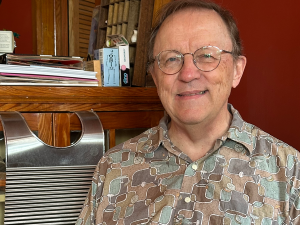
Let your eyes wander in the home of Jim Hobbs, longtime co-host of WWOZ’s Sunday afternoon Cajun and Zydeco show, and you’ll see mementos of many decades of festival-going, carnival parade attendance and a deep exploration of three musical genres - Cajun, Zydeco and Creole music - that help define the unique culture of southern Louisiana.
The Shreveport native had never really heard Cajun or Zydeco music before attending the 1975 New Orleans Jazz & Heritage Festival, then a small event with four short wooden stages where Hobbs first enjoyed performances by some of the genres’ most notable 20th century artists, including Bois Sec Ardoin, Allen Fontenot, and Clifton Chenier.
"Zydeco seems to be a very popular entryway for many people into south Louisiana music, to French music, especially for people from outside Louisiana, and it did that for me, too," Hobbs explains. That "entryway" might also be considered a very slippery slope, certainly a joyful one, if the many hundreds of records, CDs and tapes Hobbs has collected over the years are any indication. As we speak, he’s sitting nearby a shiny silver frottoir, or rubboard, made for him by Cajun accordion maker and master craftsman Clarence "Junior" Martin, who passed away this past June.
If you’re newer to Cajun and Zydeco music, Hobbs makes a great reference librarian and educator, no doubt owing to his many years as an associate professor, now emeritus, in Loyola University’s Monroe Library, as well as his passion for the music.
"There are a couple of major differences between Zydeco and Cajun music. One is repertoire, although there is some overlap. Zydeco is played more often than not by people of African descent, people who may or may not speak French. But there’s also a difference in instrumentation. Cajun musicians are more likely to play the single key diatonic accordion, and Zydeco musicians are more likely to play a larger multi-key accordion, like a double row or a triple row, and or as Clifton Chenier did, the piano key accordion."
He continues, "The dividing line is Clifton Chenier. He took a pre-existing form of music, Creole music, which was more like Cajun than Zydeco is, and created this new form of Zydeco which at least one expert says is R&B plus Cajun." He laughs, "I might say that’s an oversimplification."
Explaining more of the nuances, Hobbs says, "The washboard isn’t usually found in Cajun music. Zydeco is more likely to use electrically amplified instruments, and then also you’re more likely to get reed instruments like saxophone and other brass instruments like the trumpet in zydeco. They’re more likely to use microtones and melisma in zydeco than in Cajun music, where you have overlap and movement from one note to another, like traditional blues music does."
Like many WWOZ show hosts, Hobbs’ tenure at the station began off the air, in his case working with then Operations Manager Virginia Prescott, cataloging new CDs and LPs and working on the station’s ever-evolving music database. Before long, his current co-host Charles Laborde asked him to come aboard as an engineer for the Sunday afternoon show, and before long, Hobbs and Laborde were trading off engineering and programming and subbing for each other, as they still do today, some 30 years later.
When Hobbs talks about being an OZ show host, it sounds like he’s talking about going to a cultural heritage festival. "The number one goal, for me and for the listener, is to have fun. Maybe the number two goal, a close second, is the hope to keep this stuff alive for the future. I am just happy and really honored to be part of WWOZ. Certainly there’s no way I could have gotten involved in any other enterprise that has as many listeners and has its tentacles in as many different directions as OZ does. I’m not in the same class as a musician, but if I can bring the music through WWOZ to people who maybe have not ever heard it, or maybe forgot it from their youth, and let them know, hey, there’s something going on here that’s worth preserving, then I’m just as thrilled as I can be to part of it."